
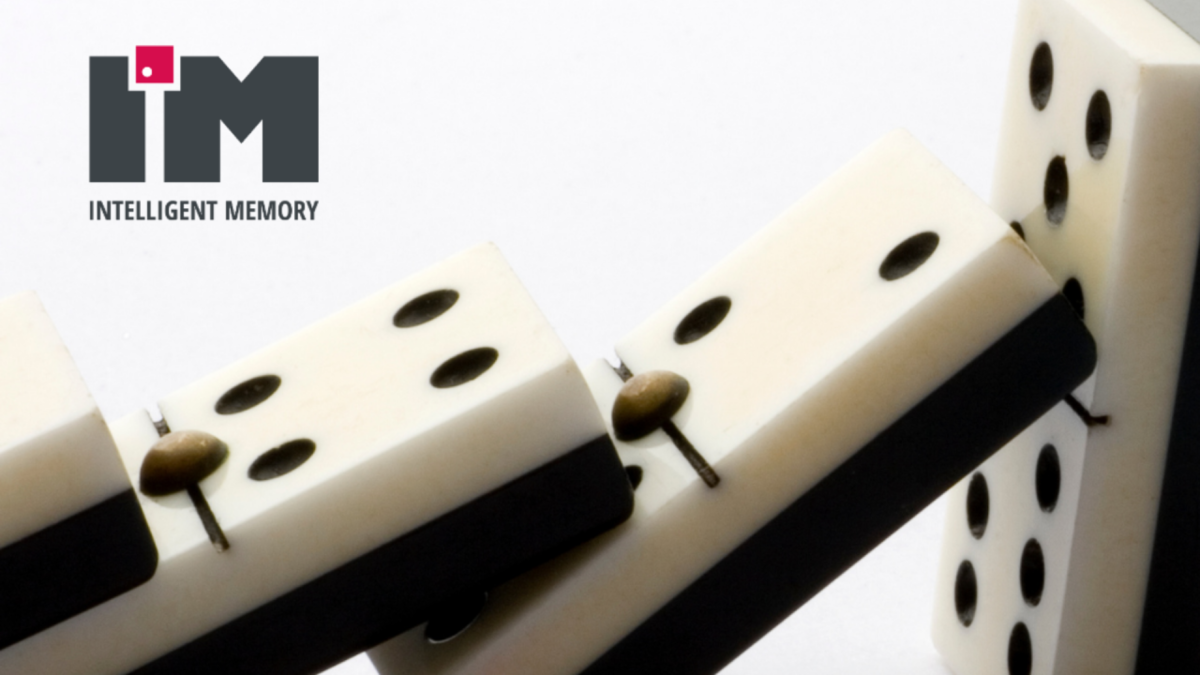
The Domino Effect in Semiconductor Memory
You can also read this article on LinkedIn.
The semiconductor memory market is currently experiencing a dramatic reallocation of manufacturing capabilities, causing ripple effects across all DRAM memory technologies and affecting all industries.
After two years of massive price slumps, during which memory manufacturers sold below cost and still piled up inventory, they are now focusing on high-margin products like High Bandwidth Memory (HBM) and Quad-Level Cell NAND for advanced SSDs. Both memory technologies are needed to satisfy the exploding demand of AI workloads and data centers. The downstream effects are being felt across the DRAM spectrum, particularly in DDR4 and DDR3.
This reallocation is not trivial — both HBM and QLC require more complex process flows and tighter integration, especially with advanced packaging techniques in the case of HBM. As a result, mature nodes previously dedicated to legacy DRAM products like DDR4 are being repurposed.
DDR4: Constrained Supply, Rising ASPs
With top-tier fabs reducing DDR4 output, supply tightness is becoming evident. Average selling prices (ASPs) for DDR4 have risen sharply and are expected to increase by another +30 percent in Q4 2025. In response, second-tier DRAM suppliers are ramping up their DDR4 production to capitalize on the price elasticity and fill the market gap.
However, the capacity shift toward DDR4 among these suppliers is not additive — it comes at the expense of older nodes and products, namely DDR3.
DDR3: Legacy Demand Meets Shrinking Output
Though largely considered a legacy product, DDR3 remains critical in industrial, embedded, and IoT applications where design stability, long product lifecycles, and broad ecosystem support are non-negotiable. Despite stable demand, DDR3 is now facing a supply-side bottleneck.
Manufacturing DDR3 is increasingly less attractive from a gross margin standpoint, especially as foundry capacity at mature nodes (e.g., 40nm, 55nm) becomes scarce and is diverted toward higher-value DDR4. Additionally, fewer mask sets and dwindling support for older process tooling further compound supply limitations.
Conclusion: Cascading Constraints Across the Memory Stack
The memory market is exhibiting a clear domino effect: the pivot to HBM and QLC is cannibalizing DDR4 production at the top, which in turn pulls second-tier capacity away from DDR3. While not demand-driven, DDR3 tightness is a classic example of opportunity cost in fab utilization, creating friction in markets where longevity, rather than performance, is the primary requirement.
System designers and OEMs relying on DDR3 should anticipate extended lead times and higher prices. When planning for 2026, they should consider proactive allocation strategies and qualify the DDR3 products from DDR3 vendors that are committed to longevity, even if lead times are currently a bit longer than usual.